Is it intuition or anxiety? How to tell the difference
I noticed something interesting when I first began getting curious about this thing that we call our “intuition”. Let me just say first, there are many ways we can understand intuition and how it speaks to us, but I will save that exploration for another time. I want to focus today on the kind of intuition that comes through as an idea or inner voice telling us to do – or not do – something. And I noticed that when I started tuning in and listening to those inner voices, I immediately realised something. Could I trust them? Were they really intuition or actually anxiety?
Why does that matter? Well, most people, I think would tell you that your intuition is your inner compass. It provides useful guidance to show you where you need to go next. Whereas, anxiety could be seen as the voice of an unprocessed trauma, or the memory of a difficult experience from the past. So, that inner voice is acting as a warning system. And, when I first began exploring this and learning from mentors, I was repeatedly given the message to ignore anxiety and trust intuition.
That obviously led to the next question: How do I know which is which? And the answer I kept receiving was: intuition feels calm, anxiety feels fearful. Or, to put it another way, intuition is the voice that comes from a place of love. Anxiety is the voice that comes from a place of fear.
Why that definition isn’t always helpful
Now, I totally “get” that definition. And I also see how it is helpful when we hold the worldview that we live in a universe of polarity. It is built around the polarity of love versus fear. If we wish to move into “darkness”, then we follow the fear. If we wish to move into “light” then we follow the love.
I actually ascribe to that worldview myself, but my personal explorations and experience led me to see a nuance in there. And that is something I would represent in the sacred geometry of the Vesica Piscis (I wrote an entire article on that, which you might want to read here). The basic message in there was that even though these polarities exist, the place in which we actually experience energy, growth and evolution is in the middle ground. This is the place where the two opposites intersect and we find balance.
So, what if this were true about intuition and anxiety as well? What if it’s not quite as black and white as, “intuition feels calm, so follow that, and anxiety feels fearful so ignore that”? What I actually discovered is something that has helped me to process the old fears and end up feeling more self-trust. And I would love to share that with you too.

What is the point of contemplating intuition and anxiety?
I believe that pretty much all of us are trying to find ways to navigate life so that we feel like we’re in control, not going to be blind-sided and not going to suffer too much. This is partly what the nervous system is trying to do, except that I would argue that is a bit more specific in that it’s trying to ensure we survive. Our conscious mind would prefer that survival wasn’t too painful. And so sometimes we experience a clash. The way in which our nervous system learned to survive as we were growing up can lead to some uncomfortable experiences in the world as an adult.
Let me offer you a specific example: Imagine your nervous system learned that it wasn’t safe to share your thoughts. Perhaps you were ridiculed at school, or maybe you had a caregiver who punished you when you spoke up. Either way, this becomes a subconscious program that you automatically use to navigate the world. It was necessary, it kept you safe as a child.
However, as an adult, you begin to notice things like this:
· Perhaps you’re held back at work because you don’t speak out and people don’t think you would be an effective leader.
· Maybe you notice that when you go out socially, you “hide” on the sidelines and don’t really say much, so people don’t notice you’re there and you struggle to connect or make new friends.
There are lots of ways this could manifest. And it may be something that feels uncomfortable. Perhaps it’s something you wish to change. And perhaps you end up exploring some kind of self-help and you’re told that learning to follow your intuition will lead you to situations where you can experience something different.
So, in essence, I’m suggesting that we feel drawn to try and follow intuition because we believe it will guide us to a smoother path through life. And I believe that most people take it even further than that. I have noticed there is some kind of belief that our intuition will take us onto the right path through life. Because if we’re currently feeling uncomfortable, we must be on the wrong path. That the discomfort is a mistake that indicates we’re missing something, somehow being bad, generally not good enough.
What if that wasn’t true?
Viewed through that lens, then it becomes very, very important to understand how to tell the difference between intuition and anxiety. We have this idea that if we can simply follow our intuition we will automatically be living on the road that brings abundance, health, romance, peace, whatever it is you desire.
Whereas, if we’re mistaking our anxiety as intuition, and we follow those anxious voices, we end up stuck on the path of misery.
Now, here’s the thing: For many of us, the advice that feeling calm = intuition isn’t as helpful as it might at first appear.
If you happen to be someone like me who has come to recognise that your nervous system is often very anxious, then you may first recognise that you almost never feel calm. So, if calm=intuition, does that mean you can’t access your intuition? Well, sadly, that may be what some people conclude. I never hear inner guidance that feels calm, so I must have no intuition.
What if the anxious voices were also a form of intuition? After all, we’re basically looking for guidance that will lead us onto the path through life. And those anxious voices will still lead us onto a path through life: It just might feel rather bumpy.
Because, as you’re probably beginning to realise, those anxious voices are still a part of your intuition. I see them as parts that have become a little distorted because they are stuck in an old reality. They are often stuck in the reality of you as a tiny helpless child. They haven’t recognised you are currently a competent adult. So, they will be guiding you to act from a place of powerlessness, and your actions will therefore reflect that. Such actions might potentially lead to more discomfort of the nature you are trying to escape.
But here’s the nuance: What if those anxious voices were simply trying to let you know that these inner child parts are there and are ready to be reintegrated so they can see you are now adult and capable? So, rather than pushing them away because they’re not the intuition you’ve been told to look for, what if you began getting curious about them? I’m not saying that means acting on them. Simply asking questions, understanding their perspective and how that helps to keep you safe. Because, ironically, anxiety can also mask as intuition…
Here’s the part to become aware of if you really want to access intuition
When the nervous system has adapted to hypervigilance and fear as its default state, anxiety can actually feel familiar. And it is easy to experience this sense of being familiar as a sense of calm. You may still have the intellectual disconnect: Your body is telling you to avoid public speaking because you feel calm when you think about staying out of sight and silent. You feel fearful when someone suggests you should share your story or your ideas on a public platform.
That may be an example of anxiety being mistaken for intuition. Let’s imagine this opportunity is linked to getting a promotion at work. Your boss calls you into their office and invites you to represent the company as a speaker at a conference and says this would give you a massive hand up in the upcoming round of promotions. You desperately want the promotion; you need the extra income. You tune into your intuition and imagine standing on stage speaking. That brings up anxiety. You imagine turning down the speaking invitation and that brings up peace. You tell yourself that this is intuition nudging you to trust that the promotion will happen anyway – another door will magically open to ensure the promotion arrives.
In fact, the fear is the old residue of that inner child that’s actually ready to grow up. Let’s imagine in this example that the job promotion is your true path for growth. There may also be a part of you that is feeling ready, feeling expansive at the thought of the promotion. A part that is imagining you sitting in that new office, managing people, receiving more wealth each month. And this is where we bring in the Vesica Piscis – the idea of balance.
Our true path through life is supposed to be one of expansion, growth, opportunity. But in order to step onto it, we have to overcome fear, heal shadows, reintegrate inner children. So, if you are looking only for intuition that feels calm and easy, you miss out on the necessary healing. True intuition can feel both expansive and fearful. It is trying to take you to a new place and new places are strange and strange is unknown and unknown is scary for the nervous system, hence the anxiety.

What is the solution?
In my last article, I looked at journaling as a way of understanding your inner world. In my next article, I will be sharing another way of connecting with your inner world. And in fact, that way will be even more deeply related to intuition.
The solution here is to understand that growth often involves challenge. And this can feel painful. Our nervous system is (understandably) going to be anxious at this prospect. But that doesn’t necessarily mean it’s wrong. The real solution for me came from becoming curious about all of my inner voices.
So, rather than pigeon-holing them into “intuition” versus “anxiety” and trying to follow a model that says, “always follow your intuition”, I began to get curious. What is this voice telling me? How is it trying to protect me? How real is this danger? Do I have tools for protecting myself now?
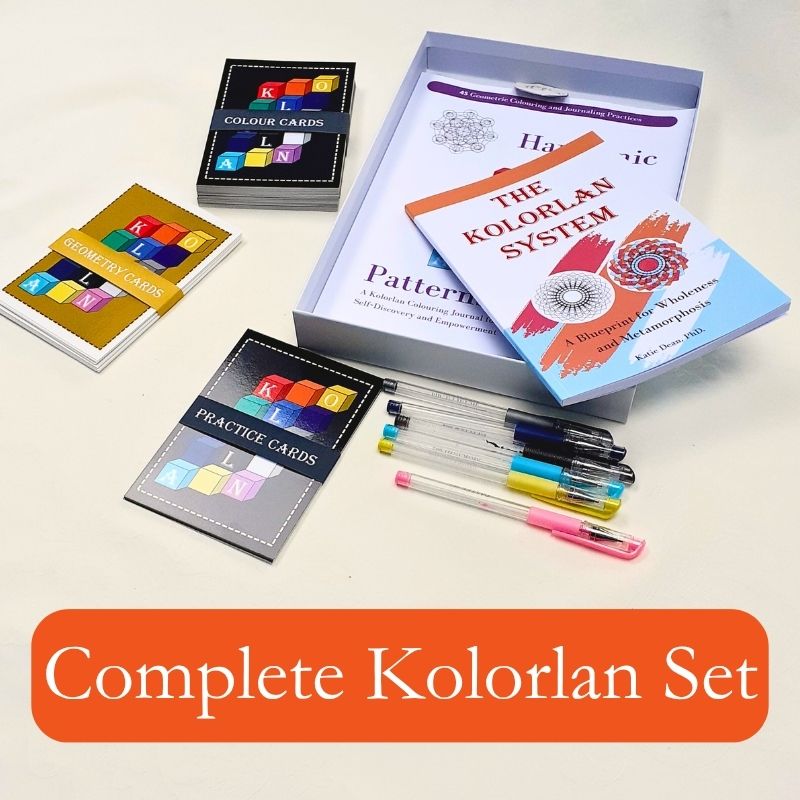
And I gathered those tools: Things that could calm me and support me through the anxiety. Yes, colouring was one of those tools. As you may know, this is exactly how I came to develop the Kolorlan System. In fact, I began to use colour as a way of simultaneously calming myself and connecting to gain the insights about what I was really feeling. Once you have those insights, you can begin to move forward in a way that honours both the safety and capacity of your nervous system, and your innate desire to grow, overcome challenges and experience more of the life you imagine for yourself.
We began by asking how to tell the difference between intuition and anxiety. Perhaps the answer is that we’re not trying to identify the “good” voice (intuition) and reject the “bad” voice (anxiety). We are actually trying to hear and understand all of them. Each voice has an important communication for our personal guidance.