Why Do I Get Angry When Someone Is Only Trying to Help?
Have you ever become angry with somebody who, when you look at the situation rationally, doesn't appear to have done anything wrong?
Perhaps they said something perfectly calmly. Maybe their comment wasn't even directed specifically at you. Or perhaps they were genuinely trying to help.
And yet something inside you reacted strongly.
Why might an apparently innocent comment or well-intentioned attempt to help make you angry?
In the previous article, we explored the idea that anger can act as a messenger, alerting us to a boundary infringement. Sometimes that boundary is fairly obvious: somebody hurts us, imposes something upon us or ignores a clearly expressed need.
But what about those occasions when the external boundary isn't obvious at all?
Well, this is rather interesting: Yes, we have boundaries to protect us from other people. But were you aware that we may also develop boundaries inside ourselves to protect us from ourselves?
What is an internal boundary?
This is really what can be happening when we talk about dissociating, cutting off parts of ourselves or disconnecting from inner children. There are lots of different ways of referring to that process that creates inner disconnection in order to allow us to survive. You may not have contemplated this before, but maybe it shouldn’t be surprising that the disconnected part has a boundary around it.
If you enjoy images, then imagine that we notice something about ourselves that creates so much overwhelm or danger for us that we have to shut that part of our personality in a cupboard and lock the door to prevent it from ever appearing again.
The difficulty is, it doesn’t cease to exist. It just ceases to be recognised and remains unintegrated, which feels deeply distressing to that part.
Equally distressing is the idea of interacting with it, let alone perhaps allowing it to leave the cupboard and reintegrate. So, we develop other parts that act like guards to ensure the (metaphorical) inner cupboard remains securely locked at all times.

Could your anger be acting as a guard?
Those guards may be the parts that become angry in response to a fairly innocent comment, or even in response to somebody trying to help us. They may have been alerted to a threat to an internal boundary – to the potential overwhelm of meeting with a disconnected part inside us.
Seen through this lens, the anger doesn't necessarily mean that the person offering help has done something wrong. And it doesn't mean that our anger is wrong either. Perhaps the anger is doing exactly what it learned to do: protecting us from something that once felt too overwhelming to face.
What might this look like in real life?
I’ll give you an example from my own life.
My paternal grandfather was called up to fight in North Africa during World War Two. Within three or four weeks of arriving there, he was captured by enemy forces and spent the rest of the war – about three years, I think – as a prisoner of war.
I don’t even know the details exactly because he chose to set a lot of boundaries with everyone else in order to try and keep himself safe.
He stipulated to his immediate family that nobody must ever mention the war. That became any war, not just World War Two, and he hated mention of Africa. My great aunt travelled a lot in South Africa during the 1980s and my grandfather refused to hear about it because it was on the same continent in which he had experienced something deeply traumatic.
He wasn’t trying to be difficult or mean to the rest of the family. He just had no awareness – or, at that time, opportunity – to process the trauma he had experienced in a different way. He had to keep himself safe by shutting others out because he couldn’t risk facing the inner parts that were so overwhelming.
However, this also kept him a prisoner of his experience. Any time someone visited and inadvertently mentioned the word war, my grandfather had to put up all his boundaries and my grandmother usually leapt in to protect him as well.
I remember one occasion when a neighbour visited and was talking about a television adaptation of Tolstoy’s novel War and Peace. Even that caused a bit of a stir!
His life shrank and shrank because of these inner prisoners and his choice to employ anger externally to protect himself from that inner world.
Is the problem always outside you?
Hopefully, you’re seeing where I’m going with this example. This type of anger may actually be inviting you to examine your inner world, rather than only your outer boundaries.
As long as we continue to keep internal parts behind walls, we may remain vulnerable to triggers. And these don't have to be nasty triggers. They might be well-meaning triggers. They might even be exciting and lovely experiences that could await us, but which cannot arrive until we are comfortable enough with our inner world to allow them closer.
Now, becoming aware of this possibility doesn't mean that every time you become angry you should assume the problem is yours. As we explored in the previous article, sometimes somebody really has crossed a boundary.
The invitation is simply to remain curious about both possibilities.
Is somebody outside me crossing a boundary that needs protecting?
Or has something outside me touched an internal boundary that is protecting something within me?
What might resistance look like?
It is possible that simple awareness of this might be all you need to begin getting curious and exploring on your own. However, the degree to which you notice yourself resisting this inner exploration can also be an indication that you may benefit from some external support.
Obvious resistance might look like shutting down, disconnecting, looking the other way, or processing the anger without exploring the trigger beneath it.
More subtle resistance may present as criticising other people or perceiving them as the problem.
And although you might expect this to appear irrational, it may not. In fact, it is also a very rational response to discomfort. It hurts to look at our deep wounds. It requires strength and courage, and we may not have those qualities sufficiently developed within us yet.
So, I’m not here to judge or criticise anyone who is reading this and wondering if I might be shining a light on one of their patterns. In fact, quite the opposite. I wouldn’t recommend trying to resolve all this on your own, or trying to do it before you feel ready.
So why might help make you angry?
Perhaps sometimes the very thing another person is trying to help us see is something that another part of us has spent years ensuring we never have to see. Their help may therefore feel less like help and more like threat. And the anger may be the guard rushing forward to protect the cupboard door.
That doesn't automatically mean you should ignore the anger. Nor does it automatically tell you that the person trying to help is right. I see it can offer another question to explore: “What is my anger protecting?”
Do you need to open the cupboard?
I feel this is an important distinction. Becoming aware that there might be something behind the cupboard door does not mean that you need to fling it open.
Perhaps the first piece of information is simply: “That's interesting. Something about this situation feels threatening to me even though I can't immediately see why.”
That awareness itself can begin to change our relationship with the anger.
If you do feel like exploring more deeply, I have personally found the work of Dr Aimie Apigian very helpful. She focuses on learning about the nervous system first in order to build our inner resources of safety and support before we approach deeper wounds.
The modality called Internal Family Systems is also well adapted to this model of disconnected parts that are protected by “managers” and “firefighters” to keep us safe from facing our deepest inner fears and wounds. So, if you feel you need more support, you might wish to explore that modality.
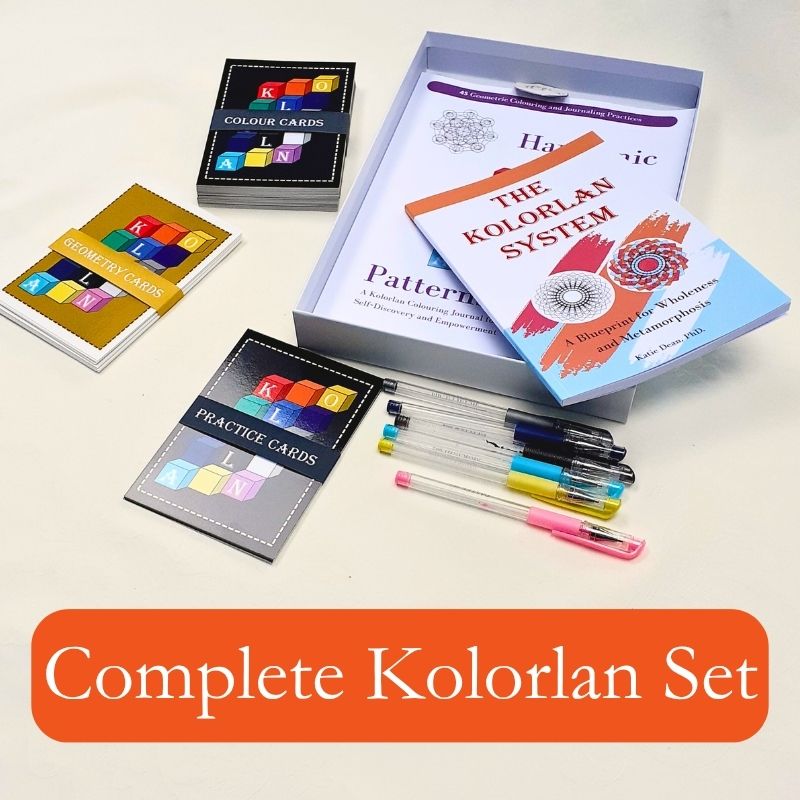
If you don’t yet feel ready – or able – to work with someone else, then I invite you to explore the Kolorlan colours as potential support for guiding your own self-enquiry. To do this, order the Complete Kolorlan Set, and then, as you follow each practice, just bring a question to mind and allow the colours to help you discover the guidance that already exists inside you. And you can still remain open to seeking external support if that feels appropriate.
The expansion we experience when we choose to take this path of opening can be wonderful. I also know firsthand that the path to reaching that point can feel very difficult, so I would never criticise or condemn someone who doesn’t yet feel ready to take it.
I simply hope that these ideas can offer you the awareness of a kind of map and potential routes, so you know what to look for if you ever desire to take that journey.