Why Is Setting Boundaries So Hard?
Perhaps you know that you need better boundaries. Maybe coaches or mentors or colleagues or friends have told you this repeatedly. Things like: You need to say no more often. Stop letting people take advantage of you. Speak up for yourself. Protect your time and energy.
And you may agree with them, be able to see all this. So, why does it still feel so hard? Why can something as apparently simple as telling another person what you need leave you feeling frightened, guilty or deeply uncomfortable? Why might you know exactly where you want to draw a line, yet find yourself unable to hold it when somebody pushes back?
Perhaps part of the difficulty is that boundaries aren't simply communication techniques that we can learn. They are intimately connected with our sense of who we are, what belongs to us and, often (albeit unconsciously), what we learned was necessary to remain safe.
What actually is a boundary?
Setting boundaries is – as I see it - about preserving your sovereignty and autonomy. In order for a boundary to be necessary, there must be more than one person (or thing, or part) in the equation: the boundary delineates where one person stops and the other begins. Or, to put it another way, it creates an autonomous space of safety for each of us.
Our boundaries tell us – and others – what we are or what is ours, and what we are not or what doesn’t belong to us. And I see the purpose of this being to create safety for both of us.
The most obvious example is probably our physical boundary: Our skin literally provides a physical boundary between us and the external world.
But our boundaries don't end with our skin: We can have physical, energetic, mental and emotional boundaries. We have a sense of personal space around us and will generally feel uncomfortable if somebody we don't know moves too deeply into that space. That “personal space” is where I perceive our non-physical aspects flow.
So, if I were to try and specify some of this, then our non-physical boundaries might include things like what we believe, what we feel, how we allow other people to speak to us, what responsibilities we accept, how much of ourselves we share and what we choose to keep private. Seen this way, boundaries aren't simply about learning to say no. They help to define who we are.

Why might boundaries feel unsafe?
If the purpose of boundaries is to create safety, it might seem strange that setting one can sometimes make us feel decidedly unsafe. But when we combine this idea of boundaries defining us along with our earlier experiences, perhaps we have a model that might help us understand this apparent contradiction.
Put very simplistically, during our developmental years, everything is an experiment to discover what works to keep us safe and what doesn’t. The strategies that ensure our survival needs are met become the programs that we run unconsciously throughout life.
As children, we are dependent upon other people. We don't learn about boundaries from a textbook; we learn through what happens when we express ourselves.
- What happens when I say no?
- What happens when I disagree?
- What happens when I become angry?
- What happens when I say that I don't like something?
- What happens when what I want is different from what you want?
If asserting ourselves or expressing our needs does not feel safe, we may learn not to do it: Perhaps our no is ignored. Maybe disagreement brings punishment, anger or withdrawal. Perhaps another person's needs consistently seem more important than ours. There are many possible experiences, and we won't all respond to them in the same way. But one possibility is that we learn that maintaining connection with another person requires us to surrender some of our own boundaries.
Then, fast-forward to adult life, years later: somebody may ask us to do something we don't want to do and we now possess the capacity to keep ourselves safe and survive alone, so we’re not reliant on pleasing this person. Yet saying no can still produce a surprisingly powerful internal reaction. The adult knows, “I'm allowed to say no.” Another part of us may have learned something quite different.
What happens when you learn to take responsibility for other people?
Sometimes the boundary between “me” and “you” can become particularly difficult to discern when we have learned to take responsibility for another person's experience.
Let’s look at an example of something I have in mind here. Parentification can occur when a child takes on responsibilities that would normally belong to the parent. Perhaps you became responsible for keeping somebody happy. Maybe you learned to monitor the emotional atmosphere around you. Perhaps being helpful, quiet, successful or undemanding seemed to make life easier for everybody. Over time, it may become increasingly difficult to distinguish between:
What do I need? – and - What do I need to do so that you are okay?
If this pattern becomes familiar enough, setting a boundary in adulthood may feel like far more than saying no to a request. It may feel as though you are failing in a responsibility that you have carried for a very long time. And this responsibility may well have become encoded in your wiring, so at a subconscious level, it can end up triggering a response that is (in essence) biologically tied to your nervous system. It’s no longer a rational, conscious choice – on some level it can become a subconscious survival mechanism that may be inviting deeper awareness than simply “make a different choice” or “just toughen up and say no”.
Weak boundaries aren't the only possibility
When we talk about improving boundaries, there can be an assumption that stronger is always better. I'm not sure that's necessarily true. As I see it, our boundaries can sit anywhere along a spectrum.
At one end, our boundaries may be so permeable that we struggle to recognise what belongs to us and what belongs to somebody else. We might find ourselves absorbing other people's opinions, emotions or expectations and adapting ourselves accordingly, without even recognising this is happening.
At the other end, boundaries can become so rigid that almost nobody is allowed close to us. And we become dogmatic in our ideas, beliefs and behaviours.
Trauma can result in both weak boundaries and isolationist boundaries – in other words, both ends of the spectrum. And perhaps both can make sense when we start to explore this through the lens of safety.
If closeness has meant losing ourselves, keeping everybody at a distance may feel safer. If maintaining connection has required us to accommodate everybody else, highly permeable boundaries may feel safer.
Neither tells us that there is something wrong with us. So, if we adopt that understanding, we can support ourselves by releasing a lot of the shame that can come with recognising we struggle with boundaries. What if this awareness is just telling us something about what we learned in earlier life? More than that, even – it’s usually a clever adaptation to help us survive. So, rather than feeling shame, can we open to the possibility of appreciation, compassion and eventually forgiveness?

What do healthy boundaries look like?
Now, if you’re willing to explore the idea that the answer isn't simply to build stronger walls, what are we actually trying to create? As I see it, healthy boundaries are flexible and discerning. Different people naturally have different levels of access to us. I find it helpful to imagine relationships as a series of concentric rings around us.
The people closest to us might be welcomed into an inner circle where we share much more of ourselves. Friends, colleagues and acquaintances may occupy progressively more distant rings. Somebody we've just met doesn't automatically receive the same access to our time, body, emotions or personal information as somebody with whom we have built years of trust.
And even those positions aren't necessarily fixed. Relationships change over time and with experience, and that means our level of trust changes. We also change, and so do those around us. So, boundaries aren't necessarily rules that we establish once and then rigidly enforce forever.
We set them, see what happens, notice how that feels and decide whether or not this was a useful boundary. If it wasn’t, we modify it in future. If it was helpful, we maintain it both with the person in question and with others in similar situations. In that sense, boundaries can become part of the process through which we discover ourselves. And this can be a journey that takes a lifetime.
But what if you don't know where your boundaries are?
We cannot set boundaries effectively until we know ourselves. A boundary is basically an outline. It outlines who we are by showing the world what we like, dislike, will tolerate, and so on. And this may be where the apparently simple advice to “set better boundaries” becomes much more complicated:
- What if you don't know what you like?
- What if you're much more practised at recognising what everybody else needs?
- What if you’ve learned to automatically override discomfort before you've even consciously noticed it?
- What if you know something doesn't feel right, but can't explain why?
Perhaps the first step isn't setting a boundary at all: Maybe it is first about reconnecting with yourself. It is worth spending some time reflecting on our likes and dislikes, our values, our motivations, our dreams and desires, to discern what truly belongs to us.
As you read that invitation, you might know where you want to begin. But if that feels confusing, then here are a few questions you could choose to explore. Grab a journal, write them down, and then write down whatever comes to you in response. Even if the answer is “I don’t know”, that’s still valuable information – it’s the invitation to start exploring that aspect of yourself.
- What feels comfortable to me?
- What doesn't?
- What am I tolerating that I don't actually want?
- Where do I notice resentment?
- When do I feel that I'm abandoning myself in order to accommodate somebody else?
- Where might I be keeping somebody at a distance because closeness doesn't feel safe?
If you immediately notice things you wish to change, that’s great, but this exercise isn’t necessarily about taking action yet. Your nervous system may appreciate it if you start small: Simply beginning to notice where your outline might be.
How can Red support you in exploring boundaries?
Within the Kolorlan System, Red is one of the colours most directly connected with safety, stability and boundaries. It represents our root chakra and mirrors Maslow’s Hierarchy of Needs in that way. Our most basic need is for the safety that secures our survival, and our ability to set and maintain boundaries is one of the ways in which we achieve that safety.
So, if you've been seeing boundary issues just as an assertiveness problem, rather than an identity and safety issue, then perhaps connecting with Red and using a Kolorlan practice offers a slightly different place to begin.
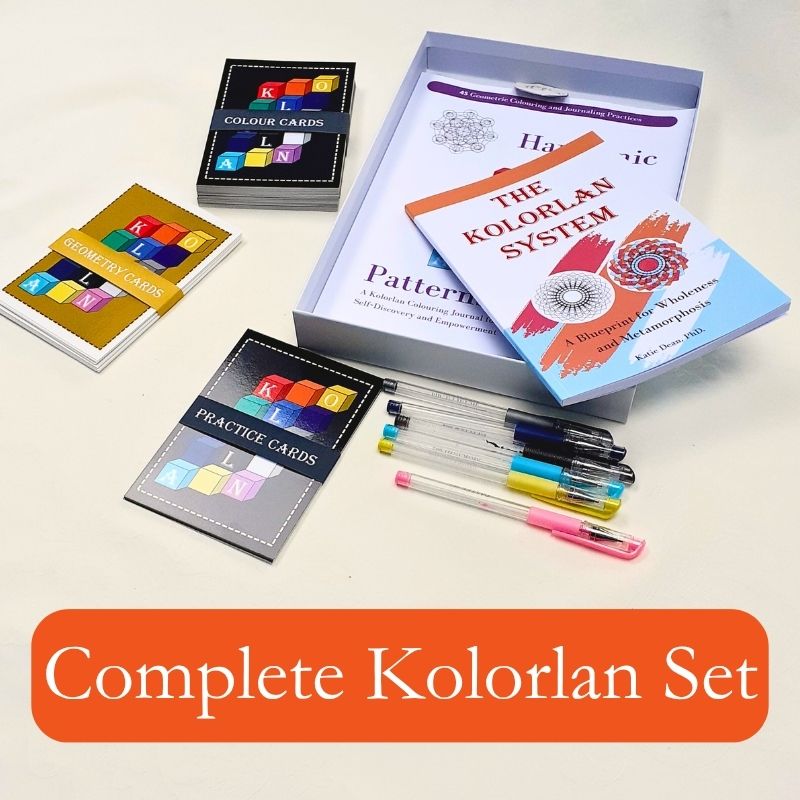
The Kolorlan colours and the practices on offer in the Kolorlan System, or through one-to-one coaching with me don't provide an external set of answers for you to follow. They offer another way of becoming curious about your own experience. The idea is, as you reconnect more deeply with yourself, your boundaries begin to become clearer too and the process of reconnection is designed to be safe, fun, creative and natural.
So, maybe it’s time to move away from self-judgment and trying to be more like others or follow the advice given to you by other people. What if you began the process of reconnecting with your own inner wisdom and inner authority instead?