Why Do I Feel Guilty When I Say No?
You know that you don’t want to do something. Perhaps you don’t have the time or energy. Maybe you simply don’t want to do it. So, you say “no”.
And then you notice you’re starting to feel guilty.
Suddenly, that perfectly reasonable “no” doesn’t feel reasonable at all. You start wondering whether you have been selfish. You imagine the other person feeling disappointed or angry. Perhaps you begin explaining yourself, backtracking or even changing your answer altogether.
So, why can saying one tiny word feel so uncomfortable? And does feeling guilty after saying no actually mean that you have done something wrong?
Why is saying no so difficult?
Setting boundaries is about preserving your sovereignty and autonomy. In order for a boundary to be necessary, there must be more than one person in the equation: the boundary delineates where one person stops and the other begins. Or, to put it another way, it creates an autonomous space of safety for each of us.
Which means that saying “no” is one of the simplest ways in which we express a boundary.
“No, I don't want that.”
“No, I don't have capacity for that.”
“No, that doesn't feel right for me.”
From an adult perspective, these can appear to be perfectly straightforward statements. But the part of us responding to the situation may be carrying much older learning about what happens when we express what we want.
During our developmental years, everything is an experiment to discover what works to keep us safe and what doesn’t. The strategies that ensure our survival needs are met become the programs that we run unconsciously throughout life. We also learn by simply absorbing and mimicking the behaviours of those closest to us.
We may learn that if we shout and scream and throw a tantrum our needs are met – perhaps we develop a very aggressive manner towards others. We may also learn that this same strategy brings a punishment down upon us. In this case we may learn that people-pleasing is the way forwards.
At one end of the spectrum, some of us are lucky enough to feel seen and heard throughout our lives, particularly in our formative years, and this develops into healthier communication patterns in adulthood. At the other end of the spectrum, we can learn submission and unworthiness – our boundaries are never honoured, so we give up even trying to set any.
So, if saying “no” creates a surprisingly powerful reaction inside you today, perhaps the reaction isn't really about today's request. Maybe, somewhere along the way, you learned that keeping other people happy helped to keep you safe.
What happens when saying yes becomes automatic?
When we first become aware that we’re not very good at setting boundaries or we notice that a lot of the time we do things to please other people even though they may not feel good for us, our natural impulse is to try and correct this.
And we probably do start by setting the odd boundary here and there. But sometimes we notice how we duck out of it at the last moment – start the conversation with the determination of saying, “no”, but find ourselves being questioned, then back-sliding and saying “yes” when we would really rather not.
Then, there are those times when we’re not even really thinking and someone says, “could you just do x?” and, out of habit, we just say, “yes, of course”, without tuning in to feel whether we really wish to agree.
But ten minutes later, we’re inwardly cursing because there is no way on earth that we willingly desire to do that thing, and we’re full of resentment for the other person and inner rage at ourselves.
And if this sounds like you, there may be something interesting to notice here: The resentment didn't necessarily appear because the other person did anything wrong. They may simply have asked a question. The sensation of resentment that we later feel could be appearing because our mouth said “yes” while an inner part of us was saying “no”.

Could your guilt be telling you something different?
We may have been taught to interpret guilt as evidence:
“I feel guilty, therefore I must have done something wrong.”
But what if the feeling itself deserves a little more curiosity?
Perhaps guilt sometimes appears because our actions genuinely conflict with our values. But perhaps there are other times, when the sensations we experience as “guilt” arise because we have done something unfamiliar – something that challenges an old pattern designed to preserve connection, approval or safety.
Those are very different possibilities and they would be inviting different courses of action from you. If the guilt is truly about wrong-doing, then appropriate action could be a conversation with the other person, and maybe that results in helping them out after all.
But if you have spent years automatically accommodating other people, saying no for the first few times may feel deeply uncomfortable even when the boundary itself is absolutely appropriate.
So rather than immediately deciding, “I shouldn't have said no,” perhaps you could ask questions like:
· What exactly am I feeling?
· What am I afraid might happen now that I've said no?
· Am I worried that this person will be angry?
· Am I afraid they won't like me anymore?
· Do I believe I need a sufficiently good reason before I'm allowed to say no?
· Do I feel responsible for protecting them from disappointment?
The answers may tell you far more than the guilt itself.
What belongs to you – and what belongs to the other person?
Our boundaries tell us – and others – what we are or what is ours, and what we are not or what doesn’t belong to us. The purpose of this is to create safety. So, it is worth spending some time reflecting on our likes and dislikes, our values, our motivations, our dreams and desires, to discern what truly belongs to us.
You see, that distinction (“yours” versus “mine”) becomes particularly important when another person doesn't like our boundary. If we are certain in our values and motivations, then it can feel easier to maintain the boundary, even in the face of a difficult reaction from the other person.
You can communicate your needs clearly and compassionately. You can listen. You can reconsider your decision if new information changes how you feel. But you cannot control the other person's response.
Perhaps they will be disappointed. Perhaps they will feel hurt. Perhaps they will become angry. And their reaction may then bring up all kinds of uncomfortable emotions within you.
That doesn't automatically tell you that your boundary was wrong. It gives you more information to explore. Just as you cannot control someone else’s emotion, you cannot expect them to manage your emotions for you. This is your job and it is, interestingly, another form of boundary.
This is where boundaries become much more interesting than simply learning how to say “no”. They invite us to explore where our responsibility ends and somebody else's begins.
Will having stronger boundaries make me selfish?
This is often the next fear: If I get used to asserting myself and not being impacted by what others think, won’t that make me a horrible, selfish person?
I don't think healthy boundaries ask us to stop caring about other people. In fact, they may help us relate more honestly.
Think about it this way: If you have a friend whom you know to be a people-pleaser, isn’t there a little part of you who, every time you ask them to do something with you and they agree, is wondering whether they really wish to be with you?
On the other hand, when you have a friend who has the capacity to say “no”, then their “yes” becomes so much more meaningful. I would argue that a genuine yes can only really exist when no is also available.
But how do you know when you genuinely want to say no?
We cannot set boundaries effectively until we know ourselves. A boundary is basically an outline. It outlines who we are by showing the world what we like, dislike, will tolerate, and so on.
And here we meet with an even deeper layer: What if you have spent so long noticing what everybody else wants that you genuinely don't know what you want?
We’re not born innately knowing who we are (well, on some level, I would argue, we do know this, but it isn’t at the level of the conscious mind). This is why boundaries are always a bit of an experiment, I believe. We set them, see what happens, notice how that feels and decide whether or not this was a useful boundary. If it wasn’t, we modify it in future. If it was helpful, we maintain it both with the person in question and with others in similar situations.
So perhaps the work begins before you ever say yes or no. This is something you can practice before you find yourself in a situation with another person. Spend a little time, pick a topic and contemplate the following:
· When you are asked a favour by someone, can you pause long enough to notice what is happening inside you?
· What do you actually want?
· How does each possibility feel?
· Are you saying yes because you genuinely want to say yes – or because saying no feels too uncomfortable?

How might colour help you explore your boundaries?
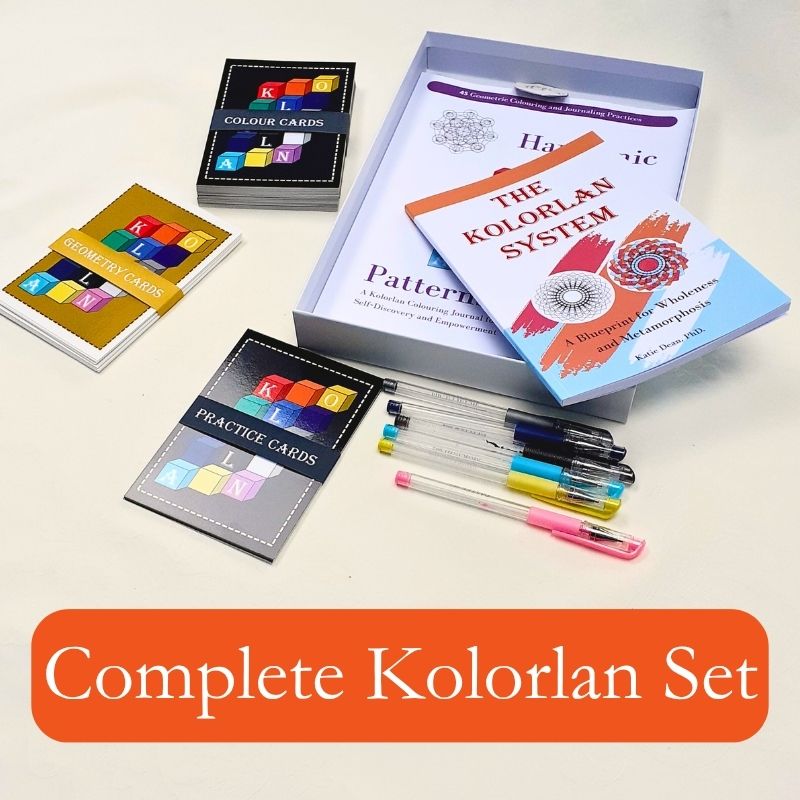
This is also where the Kolorlan colours can offer another way to explore the pattern. (If you wish to explore that, then follow this link to access the Complete Kolorlan System).
Within the Kolorlan System, three colours in particular have a natural relationship with this process: Red, Orange and Yellow.
Red is connected with safety, stability and boundaries. Rather than simply thinking about the boundary you “should” set, working with Red invites you to become curious about safety. What feels threatening about saying no? What might help you feel safe enough to honour the boundary that you notice?
Orange is connected with emotions and discovering what is true for you. If you have spent years orienting yourself around everybody else's preferences, Orange invites you back towards your own. What do you like? What don't you like? What brings you joy? What are your emotions trying to show you about yourself?
And then there is Yellow, which is connected with confidence, self-esteem and empowerment. Within Kolorlan, empowerment isn't about forcing your will upon another person. It is about learning to express your needs and defend yourself without harming others – finding that delicate balance where you can honour yourself while retaining compassion for somebody else.
Notice that there is a sequence here.
Safety. Self-knowledge. Expression.
Red. Orange. Yellow.
Perhaps struggling to say no isn't simply a communication problem. Maybe the words are only the final step in a much deeper process.
What if you still feel guilty?
Perhaps you say no and do all of this beautifully – and still feel guilty. That's OK. You don't necessarily have to make the feeling disappear before you honour your boundary. Instead, perhaps you can become curious about the feeling in exactly the same way we explored self-judgment in the previous article.
“Oh, that's interesting. I've said no and now I feel guilty. What might this be showing me?”
· You don't have to label yourself selfish.
· You don't have to label the other person demanding.
· You don't even have to decide immediately whether the boundary was right or wrong.
· You can simply notice what happened and allow the experience to give you more information about yourself.
Boundaries define who we are moment to moment. They can change over time as our understanding of ourself evolves.
And perhaps that is the most useful thing to remember: Learning to say no isn't about becoming rigid or building walls around yourself. It's part of learning who you are – what belongs to you, what doesn't, what you want to welcome into your life and what you choose to leave outside.
So, the next time you say no and feel that familiar rush of guilt, perhaps you don't need to immediately change your answer. Pause. Notice. Become curious.
Maybe the guilt isn't telling you to say "yes". Perhaps it is showing you something you are finally ready to understand.